
Projected vs Actual Release Date
A projected release date is an agency's current calculation. An actual release date is the date the person was physically released or discharged from the custody system. Those two dates can match, but they often do not. In Modoc County, the difference is especially important because the research did not locate an official public jail roster, 24-hour release feed, or 72-hour release feed. A person may leave the jail before any public web page changes, or a person may disappear from one system because of transfer rather than release to the community.
Scheduled vs actual: a scheduled or projected date is not a guarantee. A court order, hold, warrant, transfer, credit correction, discipline issue, or CDCR review can move the date. A release is confirmed when Modoc County Jail, CDCR, BOP, VINE, the court, or another custody authority records the release or custody change.
Pretrial detainees usually do not have a release date in the same sense as sentenced inmates. Someone held in Modoc County Jail before disposition may be released after bail is posted, on own recognizance, on signed promise to appear, by court order, after a warrant is cleared, after charges are dismissed, or after a transfer to another agency. The Modoc Record examples in the research show local phrases such as "booked and released on signed promise to appear" and "Court/DA booking and release." Those phrases show a custody outcome, not a fixed sentence-release calculation.
How to Find the Date
Start with the custody branch. Modoc County Jail, CDCR, BOP, and ICE do not compute release dates from one shared database. A person can pass through more than one of those systems, and each record answers a different question. The goal is to avoid asking the jail for a state-prison release date, asking CDCR about a local jail-only case, or treating a federal locator result as a Modoc jail record.
- Identify whether the case is local, state, or federal. Search the Modoc Superior Court case if you have a name or case number. Look for bail status, sentencing minutes, probation orders, transfer language, CDCR commitment, or federal/immigration hold information.
- For a Modoc County Jail release date, call the jail or Sheriff's Office. The Modoc County Jail is at 102 South Court Street, Alturas, CA 96101, and the public phone number is 530-233-4416. Ask whether the person is currently in custody, whether a release date/time is disclosable, and whether a written CPRA request is needed for the booking/release record.
- For a CDCR sentence, use CIRIS. California's public state-prison search is CIRIS at https://ciris.mt.cdcr.ca.gov/. Search by name or CDCR number and record the CDCR number, current location, commitment county, admission date, and any BPH or release-date context shown.
- Use CDCR support when CIRIS is unclear. CDCR's Identification Unit is the support channel listed in the research for help with CIRIS, at 916-445-6713, weekdays excluding holidays, 8:00 AM to 4:30 PM Pacific Time.
- Use BPH for parole-date context. For life terms, parole-suitability hearings, youth offender parole, elderly parole, or nonviolent offender parole review, use BPH parole eligibility, hearing schedules, and results. A hearing grant is not the same as final release.
- Use BOP only for federal custody. BOP's locator has federal inmates released after 1982 and federal inmates only. A past release date with no facility location means the person is no longer in BOP custody, but it does not answer local Modoc probation or court questions.
For local jail releases, the Modoc County released inmates guide explains the jail, court, VINE, and records-request sequence. For notification on a specific person, use the VINELink Release Check page after you understand which custody system the person is in.
Modoc Jail Date Calculations
For a Modoc County jail sentence, the release date depends on the sentence imposed, actual days in custody, local jail calculation, credits, holds, warrants, discipline, and any later court order. Penal Code section 4019 is the main California county-jail conduct and work credit statute for many local cases. The official statute is detailed and has changed over time, so a public page should not calculate a release date for a named person. The practical point is narrower: county jail sentences can be shortened or affected by credits unless a statute, court order, discipline issue, sentence type, or other law limits the credit.
Penal Code section 2933.1 is a major limit for violent felonies listed in Penal Code section 667.5(c). The research states that section 2933.1 caps worktime credit at no more than 15 percent for covered people and applies the same cap to pre-CDCR county-jail confinement. In plain language, this is where the common "85 percent" idea comes from for many violent-felony sentences. It is not a universal rule. Many Modoc local cases are not governed by that cap, and some state-prison cases involve CDCR regulations, Proposition 57 review, resentencing, or parole-board processes.
Local custody status can change quickly in a small jail. The research notes that Modoc County Jail has 43 beds and that the Grand Jury report described early releases as one operational response to space pressure. That does not create a predictable entitlement to release, and it should not be used to forecast a named person's date. It does explain why old booking posts or informal counts are weak evidence. When timing matters, call the jail, check the court, or request the written booking/release record from the Sheriff's Office.
CDCR EPRD, MEPD, and NPED
California state-prison release dates should use CDCR and BPH terminology rather than a generic "projected release date" label. The BPH parole eligibility page defines Earliest Possible Release Date, or EPRD, as the date a determinately sentenced person will be released based on the court sentence less applicable credits. The same page defines Minimum Eligible Parole Date, or MEPD, as the date a life-term inmate becomes eligible for parole consideration based on the sentence imposed by the court less applicable credits. MEPD is eligibility, not automatic release.
The BPH nonviolent offender parole review material adds Nonviolent Parole Eligible Date, or NPED. NPED is used for eligible nonviolent determinate terms and relates to Proposition 57 review. The research notes that eligible people may be referred before NPED under BPH timing rules when they are more than 180 days from EPRD, and that people approved for release are processed by CDCR after the Board decision under the stated review process. These are state-prison rules. They do not apply to an ordinary Modoc County Jail booking that never entered CDCR custody.
The screenshot below comes from the BPH parole eligibility source in the manifest. It supports the EPRD and MEPD terminology used for California state-prison release-date questions.
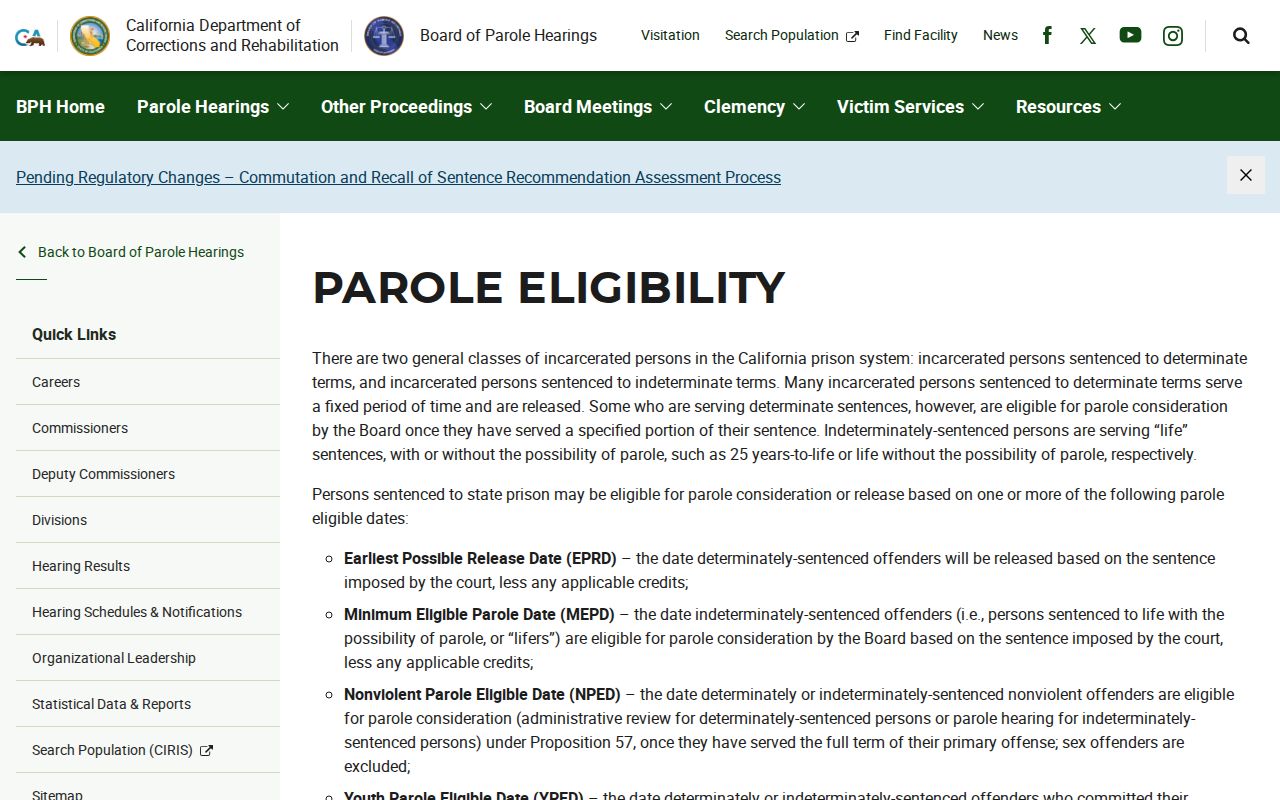
Use this source as a terminology check, then verify a named person's record through CIRIS, CDCR support, BPH schedules or results, DAPO, or the court case. A public explanation of EPRD, MEPD, or NPED is not the same as a certified calculation for a specific inmate.
Credits and 85 Percent Limits
Good-time, work-time, and conduct-credit rules are why two people with similar sentence lengths may have different dates. Under Penal Code section 4019, many county-jail cases can involve conduct or work credits. Under Penal Code section 2933.1, violent-felony cases listed in section 667.5(c) are credit-limited to 15 percent. The release-date page should state those rules carefully because using "85 percent" as a universal California rule would be wrong.
State-prison credit calculations can also move because CDCR credits, disciplinary losses, restoration, resentencing, amended abstracts of judgment, Proposition 57 review, and court orders can affect the date. CDCR case records staff process abstracts, minute orders, and release-related court documents, so a court change may not be reflected instantly in every public lookup. If a family member believes the release date is wrong, the proper route is to contact the record-holding agency, not to recalculate from a statute summary.
| Rule or source | What it affects | Modoc verification route |
|---|---|---|
| Penal Code section 4019 | Many county-jail conduct/work credit calculations. | Jail record, court sentence, or Sheriff's Office records request. |
| Penal Code section 2933.1 | 15-percent credit cap for listed violent felonies, including covered jail time. | Court conviction/sentence record, jail/CDCR calculation. |
| BPH EPRD | Determinate state-prison release date based on sentence less credits. | CIRIS, CDCR Identification Unit, BPH information. |
| BPH MEPD | Parole eligibility date for life terms with parole. | BPH eligibility, schedule, and result records. |
| BPH NPED | Nonviolent offender parole review timing under Proposition 57 processes. | BPH nonviolent offender review and CDCR records. |
Why Release Dates Change
A release date changes when the legal basis or custody calculation changes. The safest public explanation is to identify the category of change, then send the reader to the agency that holds the record. Do not promise a date based on a sentence length alone.
| Factor | How it can move the date | Where to confirm |
|---|---|---|
| Court order | Bail, own-recognizance release, dismissal, resentencing, warrant recall, or time-served order can change custody status. | Modoc Superior Court portal or document access at 530-233-6516. |
| Credits | Conduct/work credits, credit limits, or recalculation can shorten or delay the projected date. | Jail, court, CDCR, or BOP depending on custody type. |
| Holds or warrants | A person may finish one case but remain held for another agency, warrant, detainer, or transfer. | Jail record, court case, issuing agency, BOP, or ICE if applicable. |
| Discipline | Disciplinary losses or restorations can affect state-prison and some jail credit calculations. | CDCR or jail records, not a public estimate. |
| Parole review | A BPH grant, denial, continuation, postponement, or later review can affect state-prison release timing. | BPH schedules/results, CDCR, and DAPO. |
| Transfer | Release from Modoc County Jail may mean transport to CDCR, another county, BOP, ICE, or another authority. | Modoc jail release record plus receiving agency. |
Confirming the Date
To confirm a county jail release date, call the Modoc County Jail at 530-233-4416 or request the releasable booking/release record from the Sheriff's Office. A narrow CPRA request should identify the person by full name, date of birth if known, booking or arrest date, arresting agency, and case number if known. Ask for the booking date/time, release date/time, release type or reason, charges or holding authority, bail or release authority, and transfer destination if one exists. Do not request medical details, victim details, sealed juvenile records, or investigative material unless you have a legal right to those records.
To confirm a state-prison release date, use CIRIS and CDCR support. If parole or review is involved, use BPH hearing schedules, BPH results, and DAPO. Eligible victim-services users may use CDCR Form 1707 or e1707 for notices after a person is in CDCR. To confirm a federal release date, use BOP's inmate locator. To confirm an immigration custody event, use ICE's locator only when the person is in the relevant ICE custody scope.
For notifications, California VINE / VINELink can alert users to release, transfer, escape, return, or other custody changes when the relevant data feed supports it. VINE should be treated as a status and notification layer, not as the certified calculation of a sentence. If VINE is absent, stale, or unclear, verify through the jail, court, CDCR, or the appropriate federal system.