
Parole vs Probation in Modoc
In Modoc County, parole and probation are often confused because both can follow a jail or prison release and both can impose reporting rules. They are not the same record path. Probation is usually created by a Modoc Superior Court order in a local criminal case. It may follow a county jail sentence, a suspended sentence, a plea disposition, or a court-ordered release condition. Parole is tied to state prison custody or a parole-board decision. If the person was transferred from the Modoc County Jail to the California Department of Corrections and Rehabilitation, the release and supervision questions move away from the jail at 102 South Court Street and into CDCR, the Board of Parole Hearings, and DAPO.
Use the court case first when the release happened from Modoc County Jail. The court record can show probation terms, future hearings, warrant recalls, bail or own-recognizance release, sentence completion, and whether the person was ordered to report to probation. Use CDCR and DAPO when the person served a state-prison term, had a CDCR number, or appears in a BPH schedule or result. A jail release record can say that a person left local custody, but it does not prove that county probation, state parole, or no supervision applies.
| Question | County Probation | State Parole |
|---|---|---|
| Who creates it? | Usually the Modoc Superior Court through a criminal case order. | CDCR release, BPH action, or state-prison supervision rules. |
| Who supervises it? | Modoc County Probation Department in Alturas when the case is local. | CDCR Division of Adult Parole Operations, generally through a Northern Region unit. |
| Best first record | Modoc Superior Court portal or document access at 530-233-6516. | CDCR CIRIS, BPH schedule/results, DAPO contact, or CDCR records. |
| Release meaning | Released from jail may still mean pending court dates and probation conditions. | Released from prison may mean release to parole, pending review, or later parole discharge. |
Working definition: probation is local court supervision; parole is state post-prison supervision. Mandatory supervision, post-release community supervision, and other California release statuses can add complexity, so confirm the exact term from the court, CDCR, or supervising agency instead of relying on a label in a third-party result.
Verify Post-Release Supervision
The practical verification path is a sequence, not a single lookup. Modoc County did not surface a county-published probation roster, parole roster, or absconder list in the research materials. That means the reliable route is to identify the source of the release, then ask the agency that has legal custody or supervision authority. Use official records and purpose-neutral questions. Do not treat social posts, old booking summaries, or commercial warrant pages as proof that a person is on supervision or has violated supervision.
- Start with the release source. If the person left Modoc County Jail, call the jail or Sheriff's Office at 530-233-4416 for immediate custody-status questions and ask whether a written release record must be requested. If the person left CDCR, use CIRIS or CDCR support first.
- Search the Modoc Superior Court case. The court portal can show case status, recent filings, hearing schedules, parties, disposition, sentencing minutes, probation orders, warrant recalls, and future hearings. If the portal shows the case but not the document needed, call 530-233-6516 for document-access instructions.
- Contact Modoc County Probation only when the case points there. The CPOC Modoc listing gives the Probation Department at 326 South Main Street, Alturas, CA 96101, phone 530-233-6324, and fax 530-233-6363. A probation office may not disclose every supervision detail to the public, but it is the local agency named in the research for court-ordered probation supervision.
- Use CDCR routes for state parole. CIRIS is the state-prison search path. CDCR's Identification Unit, BPH schedules and results, and DAPO Northern Region contacts are the relevant state systems when the Modoc case became a CDCR sentence.
- Use California VINE for custody-change notices. VINELink can help with release, transfer, escape, return, or custody-change notifications when data are available. It is a notification layer, not the master parole or probation file.
If the question is "is this released person on parole or probation," a missing online result is not an answer. The person may be under another name variation, may have been transferred, may have a sealed or restricted case, may be supervised outside Modoc, or may have no supervision. Tie each conclusion to the source that actually has authority over that part of the record.
Modoc Supervision Contacts
The local probation contact is concrete. The Chief Probation Officers of California listing for Modoc identifies Stephen Svetich and gives the Modoc County Probation Department contact at 326 South Main Street in Alturas. Use that office for local probation questions after the court record shows probation or another local supervision order. Do not assume that every released jail detainee reports there. Some people are released on bail, signed promise to appear, time served, dismissal, transfer, or no continuing local supervision.
Modoc County Probation Department
Address: 326 South Main Street, Alturas, CA 96101
Phone: 530-233-6324
Fax: 530-233-6363
Use for: local probation or court-ordered supervision after the Modoc Superior Court case indicates probation, mandatory supervision, or a related release condition.
State parole is different. CDCR's Division of Adult Parole Operations is organized by regions and units. The Northern Region directory lists headquarters in Sacramento and units that include Redding, Red Bluff, Chico, Auburn/Sierra, and other Northern California offices. The research also notes a CDCR rural parole article describing Alturas home visits from the Redding rural-parole context. For a released state-prison inmate living in Modoc County, the supervising agent may be part of a regional rural unit rather than a public storefront in Alturas.
The screenshot below comes from the CPOC Modoc probation contact source identified in the image manifest. It is included as a source lead for the local probation contact, not as a substitute for calling the office or reading the court order.
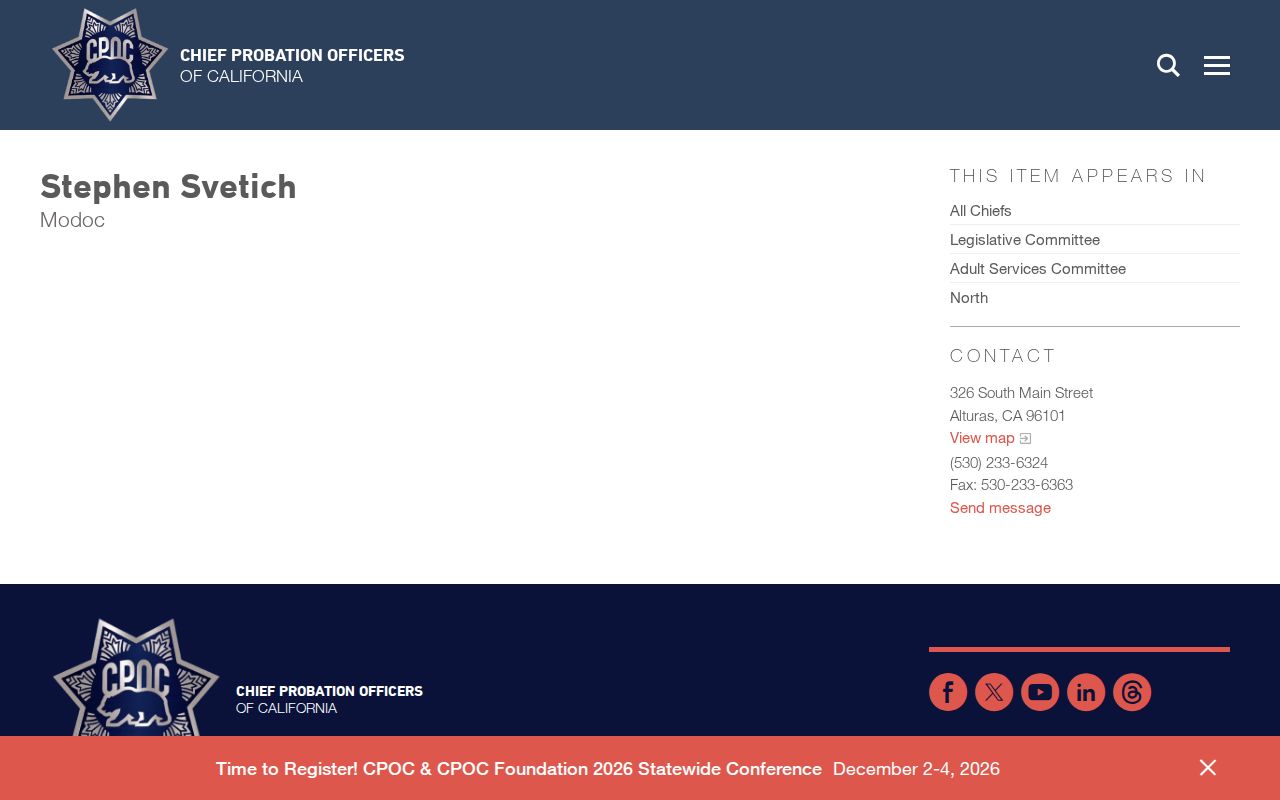
Use the image as a pointer back to the official contact source. Supervision status still needs to be verified from the court, probation department, CDCR, or DAPO, because a public contact page does not say whether a particular person is currently supervised.
BPH Hearings and Results
For state-prison cases, parole may depend on the California Board of Parole Hearings. BPH is within CDCR and publishes hearing schedules, parole-suitability results, and parole-eligibility information. The hearing schedule page says schedules identify date, time, location, and whether the hearing is by video conference or in person. The research date noted that schedules were updated weekly on Thursday morning and that the schedule page linked to both parole suitability hearing results and CIRIS.
BPH result language should be read carefully. A grant means the person was found suitable and recommended for release to parole, but the decision is subject to later review by BPH Legal Division and the Governor's Office before it becomes final. A denial means the person was not found suitable. A continuation means a hearing started but was not completed. Other result documents can include postponements, waivers, stipulations to unsuitability, and rescission-related events. None of those terms is the same as a confirmed street release from Modoc County Jail.
The screenshot below comes from the BPH hearing schedule source listed in the manifest. It supports the state-prison hearing route for Modoc cases that have moved into CDCR custody.
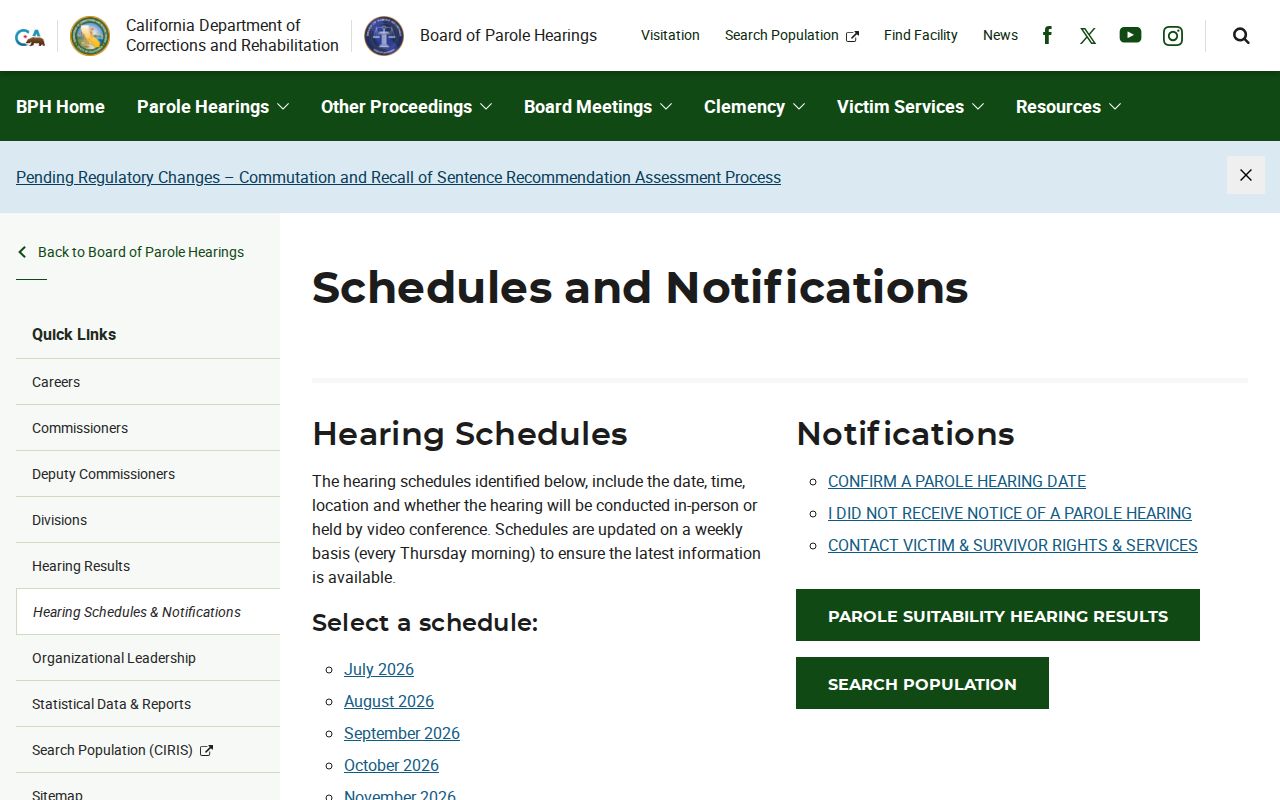
After a BPH schedule or result is found, confirm the final custody outcome through CDCR, DAPO, court records, or victim-services notices where applicable. A parole hearing grant and an actual release date are related events, but they are not interchangeable.
Conditions, Violations, and Warrants
Probation and parole conditions can include reporting requirements, treatment or program participation, residence rules, travel restrictions, search conditions, no-contact orders, restitution, drug or alcohol testing, and future court appearances. The specific conditions come from a court order, parole document, or supervising agency, not from a general released-inmate website. If a Modoc court case shows probation, read the sentencing minute order or probation order. If the person is on CDCR parole, use CDCR and DAPO records or official parole documents.
Absconder and warrant research requires caution. The research did not find a Modoc County-published absconder or warrant list for this site to quote. CDCR has public alert and wanted-offender resources in limited contexts, and California Megan's Law may show registrants when state law allows disclosure, but neither one is a general Modoc release list. The safest route is to check the court case for warrants or bench-warrant activity, contact the supervising agency for supervision-status questions it can lawfully answer, and avoid treating a third-party warrant page as official confirmation.
A release record can also show transfer rather than freedom from custody. Someone may leave the Modoc County Jail for CDCR, another county, BOP, ICE, or another law-enforcement agency. That may close the local jail custody event while opening a new state, federal, immigration, or court supervision event. When a release appears tied to a hold, detainer, warrant, or transfer, match the next question to the agency that received the person or issued the hold.
Rural Reentry Handoffs
Modoc's small-county setting matters. The research notes that the county jail has 43 beds and that planning materials for the proposed adult rehabilitation facility discussed Life Skills, Nurturing Parenting, Behavioral Health assessments, Medi-Cal coverage coordination near release, and post-release class or service connection. Those details do not prove that a particular released person received services, but they do explain why local release questions can involve court, jail, probation, behavioral health, and community-service handoffs rather than a simple online roster row.
The rural parole detail is even more specific. CDCR described Alturas home visits in the Redding rural-parole context and noted the drive time, weather, and mountain-pass complications that can affect supervision work. That local fact is useful when a family member expects a nearby parole counter in Alturas. For CDCR parole, the correct contact may be a Northern Region unit or the supervising agent, not the Modoc County Probation Department.
How Supervision Ends
Supervision can end by court order, successful completion, revocation, discharge from parole, sentence expiration, transfer to another jurisdiction, or another legal event. A probation end date may be reflected in a Modoc Superior Court order, minute entry, or probation record. A parole discharge may be reflected in CDCR or DAPO records, and eligible CDCR victim-services users may receive notices for custody-status changes such as release, transfer, or discharge from parole. For the broader release-record path, use the Modoc County released inmates search guide to match the jail, court, CDCR, federal, or immigration route to the person's case.
The useful public-record question is narrow: which agency has authority, what does the official record say, and what source can verify the status today? Keep the lookup tied to release confirmation, supervision status, court compliance, notices, or personal knowledge.